
Inner Page Background

512.657.8671

Home » Archives for Olga Gilmore » Page 14

Author Archive

VA Home Loans

Today, on Veterans Day, we honor those who have served our country and thank them for their continued dedication to our nation. In the United States, there are many valuable benefits available to Veterans, including VA home loans. For over 75 years, VA home loans have provided millions of Veterans and their families the opportunity to purchase their own homes.

As we consider the full impact of VA home loans, it’s important to both understand these great options for Veterans and to share them with those we know who may be able to benefit most. For a variety of different reasons, many Veterans don’t use their VA home loan options, so being knowledgeable about what’s available and how they work may be a game-changer for many.

Facts about 2019 VA Home Loans (most current data):

  • 624,546 home loans were guaranteed by the Veterans Administration.
  • 306,879 VA home loans were made without a down payment.
  • 2,055 grants totaling $118 million were provided to help seriously disabled Veterans purchase, modify, or construct a home to meet their needs.

VA Home Loans Often Offer:

  • No down payment options as long as the sales price isn’t higher than the home’s appraised value.
  • Better terms and interest rates than loans from other lenders.
  • Fewer closing costs, which may be paid by the seller.

The Low Down

The best thing you can do today to celebrate Veterans Day is to share this information with those who can potentially benefit from these loan options. For more information, contact a local real estate professional who can assist you in the process. Thank you for your service.

Buy v. Rent?

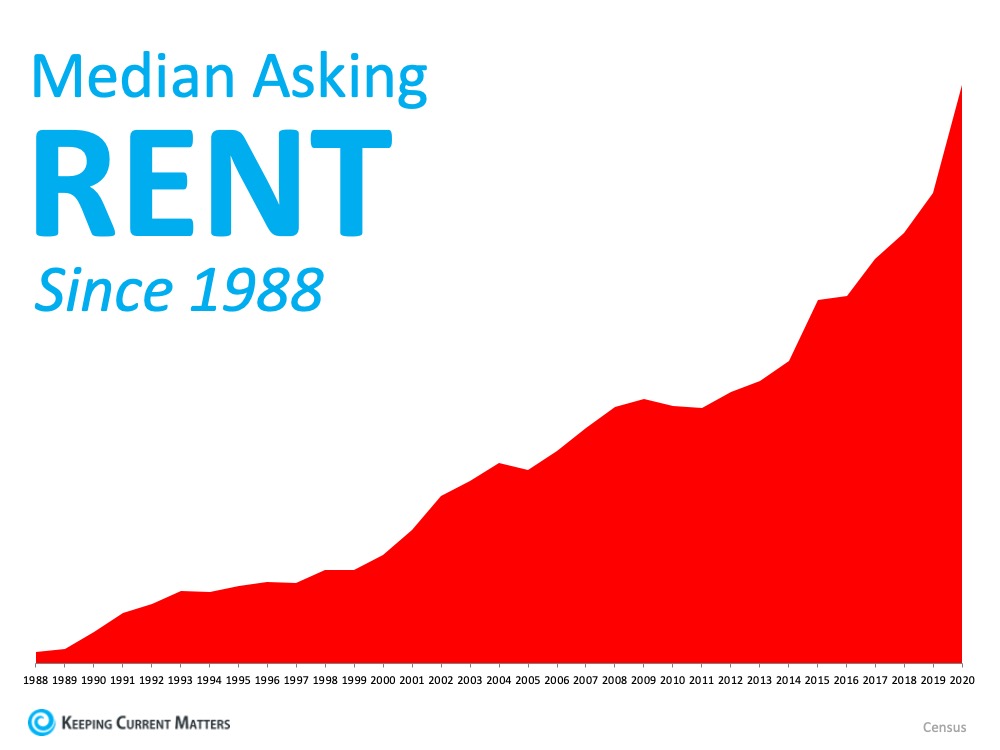
According to the U.S. Census Bureau, median rent continues to rise. With today’s low mortgage rates, there’s great opportunity for current renters to make a move into homeownership that stretches each dollar a little bit further.

While the best timeline to buy a home is different for everyone, the question remains: Should I continue renting or is it time for me to buy? The answer depends on your current situation and your future plans, so here are some thoughts to help you decide if you’re ready to own a home of your own.

1. Rent Will Continue to Increase

This is one of the top reasons why renters decide to move because in most cases, rent will continue increasing each year. As noted above, the U.S. Census Bureau recently released its quarterly homeownership report, and as the graph below shows, median rent is climbing year after year. When you own a home, you’ll lock in your monthly payment for the life of your loan, creating consistency and predictability in your payments.

2. Freedom to Customize

This is a big decision-making point for many people who want to be able to paint, renovate, and make home upgrades. In many cases, landlords determine all of these selections and prefer you do not alter them as a renter. As a homeowner, you have the freedom to decorate and personalize your home to truly make it your own.

3. Privacy

When renting, your landlord has access to your space in case of an emergency. If you own your home, however, you’re the one to decide who can come inside. Given today’s health concerns around the pandemic, this may be a growing priority for you.

4. Flexibility for Relocation

If you’re renting, it may be easier to move quickly should you have a job transfer or simply decide it’s time for a change. When you’re a homeowner and need to sell your house, this might take a little more time. Today, however, with the housing market’s low inventory, this may no longer be the case. Homes are selling at a record-breaking pace, so you may have more flexibility than you think.

5. Building Equity

When you pay your rent, your landlord earns the equity the property gains. If you own your home, the benefits of your investment go directly toward your net worth. This is savings you’ll be able to use in the future for things like sending children to college, starting a new business, buying a bigger home, or simply downsizing to save for retirement.

6. Tax Advantages

When you own your home, there are additional advantages that work in your favor as well. You can deduct things like your property taxes and mortgage interest (Always make sure you check with your accountant to see which tax-deductible benefits apply to your situation). When you rent, however, the tax benefits are directed to your landlord.

So…

It’s up to you to decide if you’d prefer to rent or buy, and it’s different for every person. If you’d like to learn more about the pros and cons of each, as well as resources to help you along the way, contact a local real estate professional to discuss your options. This way, you can make a confident and informed decision with a trusted expert on your side.

The Color Psychology Behind a Relaxing and Soothing Home

Color is one of the most relative means of expression, as the famed color theorist Josef Albers once said. It’s also one of the most evocative. From the Red Room in the Black Lodge to the pastel pink pastry boxes of Mendl’s Bakery, color conjures up strong psychological associations. Should we feel apprehensive—as is the case with David Lynch’s unsettling interiors—or revel in sweetness, as in Wes Anderson’s surreal dreamscape? Just as film directors reach for specific colors to create a mood, so too may we. During a hellaciously stressful and anxious time wrought by the novel coronavirus, color can become a coping mechanism.

Experts at the Pantone Color Institute, a global color consultancy, have been thinking a lot about the COVID-19 pandemic’s cultural effects, and how color fits into the picture.

“We look at things through the lens of color,” says Laurie Pressman, vice president of the Institute. “Of course, this is a public health crisis, and it’s not like a public health crisis is looked through a lens of color, but we’re thinking about: How is this going to affect what people need from color? How is this going to affect what people want from color? How can we help use color as an antidote to what’s going on?”

Images of color swatches, which are nature-based hues, arranged horizontally
Pressman calls these colors “a nature-infused palette of health-giving hues conveying contentment”: PANTONE 17-5722 Bottle Green; PANTONE 14-4318 Sky Blue; PANTONE 14-0627 Shadow Green; PANTONE 20-0161 Beetle Wing; PANTONE 17-2411 Toadstool; PANTONE 17-1446 Mango; PANTONE 17-0949 Chai Tea; PANTONE 18-4728 Harbor Blue; PANTONE 17-0330 Turtle Green

The Pantone Color Institute’s primary business is trend forecasting and advising brands on what colors they should consider for their products. This involves predicting what people might gravitate toward based on what’s happening in the world. Through initiatives like its popular Color of the Year program, now in its 20th year, Pantone also works to familiarize people with the language of color and color as a form of expression and communication. While Pressman says it’s too soon to speculate on how the pandemic will affect consumer marketing, she is thinking about the pervasiveness of uncertainty, stress, and anxiety right now and how that might lead us to seek out products and spaces that are soothing, relaxing, and comforting. And color can be a significant player in achieving those sensibilities.

It wouldn’t be the first time hues were used to soothe. For hundreds of years, color theorists have ascribed psychological characteristics to hues based on intuition. Warm colors—like reds, yellows, and oranges—are associated with active feelings, while cool colors—like blues and greens—are widely believed to be calming and healing.

Chromotherapy (considered alternative medicine to some and pseudoscience to others) has been hawked as a remedy for illness since Ancient Egypt. In the early 1900s, a New York City psychiatric hospital even had a “color ward” to treat patients: a black room to soothe “manic” patients, a red room to treat “melancholia,” violet for “insanity,” blue and green rooms for the “boisterous,” and a white room for someone who is “practically well,” as a 1902 New York Times story stated. “[S]o completely is a patient surrounded by an atmosphere of a particular color, deemed best by physicians for his particular mania, that the vibrations must act on him,” the reporter wrote. Rudolf Steiner, who founded Waldorf education, believed that classrooms should be painted in specific colors based on the developmental age of students.

The interest in how color affects mood, and maybe even mental health, hasn’t waned since the early 1900s. Recently, researchers interested in the effects of interior design on stress and anxiety have studied the body’s response to color, hoping to find some scientific backing to anecdotal assumptions. In a small experiment, researchers at the Aalborg University of Copenhagen blindfolded subjects, connected them to EEG machines (which register brain activity), and exposed them to different colors of light. Their brains were more active when their bodies were exposed to red and blue light. Green light yielded calmness and relaxation. Another study found that blue light helps people relax more than if they were using white light.

Images of color swatches, which are bright and bold colors, arranged horizontally
Pressman suggests these colors as energizing hues that brighten moods: PANTONE 14-0957 Spectra Yellow; PANTONE 17-3932 Deep Periwinkle; PANTONE 17-1464 Red Orange; PANTONE 20-0147 Diode Blue; PANTONE 18-3027 Purple Orchid; PANTONE 16-4728 Peacock Blue; PANTONE 15-5519 Turquoise; PANTONE 12-0642 Aurora; PANTONE 20-0179 Leprechaun Dust

Science is still trying to prove how color affects our bodies and minds in a quantifiable way, but Pantone’s decades of experience in the area have led to an intuitiveness about what color can accomplish for our moods. Pressman believes that color can serve as an antidote to today’s trying times in three ways: by calming us, by soothing us, and by offering some much-needed positive energy.

“Now is not the time for grays,” Pressman says, the color many people gravitated toward after the 2008 financial crisis, to which the COVID-19 pandemic is drawing comparisons. Instead, she recommends meditative nature shades like blues, greens, and browns as calming options. To soothe us, she suggests colors that gently warm us, like pastel pinks, burnt oranges, and terra-cotta shades. To brighten moods, she looks to reds and yellows.

“I need to feel positive because of all the uncertainty in the air and am trying to summon up the energy,” Pressman says. “So to put on that red shirt, to put on that yellow pillow, or something that sparks optimism and energy.”

Pantone’s Color of the Year for 2020 is Classic Blue, which was chosen for its association with feelings of calm, confidence, and connection. Classic Blue was finalized in the summer of 2019, well before the pandemic, but it feels especially relevant now.

“We just knew going forward, people needed confidence, they needed stability, they needed strength, they needed dependability,” Pressman says of picking the color of the year, which is more about a cultural statement than trend forecasting. “We’re looking forward, but at the same time we are fearful and we need that solid foundation so we can comfortably and confidently cross that bridge into this new era. This kind of color—with its ability to elicit feelings of calm, with its feelings of sincerity, and a feeling of anchoring and continuity—fosters resilience and can be protective.”

Images of color swatches, which are pastels and light grays, arranged horizontally
Pressman says that pastel hues are a very livable and soothing colors to consider. Shown here are PANTONE 13-2808 Ballet Slipper; PANTONE 12-0712 Vanilla; PANTONE 13-0908 Parchment; PANTONE 14-4102 Glacier Gray; PANTONE 14-4112 Skyway; PANTONE 15-4502 Silver Cloud; PANTONE 16-1109 Greige; PANTONE 17-4015 Infinity; and PANTONE 18-5204 Granite Gray

When it comes to applying these colors to our homes, Pressman suggests thinking about how you want to feel when you step inside the door, how you want to feel in specific rooms, and using color to create those moods. For example, a very bright optic white could look beautiful, but feel stark. A creamier white or a white with brown undertones could make the color more warming. Using yellow in an entry hall, she says, can add sunniness. Meanwhile, something like a terra cotta could add instant warmth. Pastel hues, she says, are very popular right now and very livable.

“I think a lot of people are living in really open spaces, so you have to find ways to inject color,” Pressman says. “It may not be that a room has only this one color, so even if you are in a warm room, it doesn’t mean you can’t bring in some energizing reds. … It’s all about the balance here of warm and cool. It’s not just one or the other. That balance is really important.”

For as many colors that exist in the world, there as many theories about how they make us feel. “Color deceives continually,” Albers wrote, referring to how adjacent colors change the way we see the same hue. When it comes to using color to make you feel happier and more comfortable in your home, go with the combination that makes you feel good, however you define it.

Curbed; By Diana Budds  Apr 27, 2020, 1:00pm EDT

Should You Wait To List Your House?

Many industries have been devastated by the economic shutdown caused by the COVID-19 virus. Real estate is not one of them.

Mark Fleming, Chief Economist for First American, just reported:

“Since hitting a low point during the initial stages of the pandemic, the only major industry to display immunity to the economic impacts of the coronavirus is the housing market. Housing has experienced a strong V-shaped recovery and is now exceeding pre-pandemic levels.”

Buyer demand is still strong heading into the fall. ShowingTime, which tracks the average number of buyer showings on residential properties, just announced that buyer showings are up 61.9% compared to the same time last year. They went on to say:

“Normally, real estate activity begins to slow down in the late summer, but this year it peaked in July, August and into September.”

There Is One Big Challenge

Purchaser demand is so high, the market is running out of available homes for sale. Just last week, realtor.com reported:

“Since the beginning of the COVID pandemic in March, nearly 400,000 fewer homes have been listed compared to last year, leaving a gaping hole in the U.S. housing inventory.”

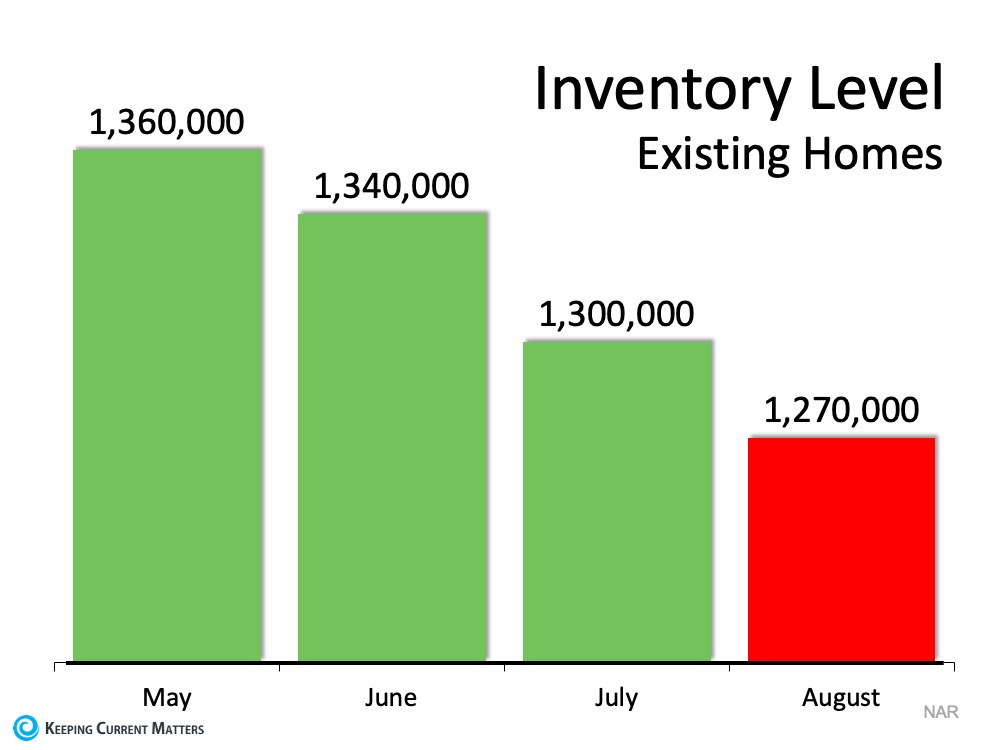
The National Association of Realtors (NAR) revealed that, while home sales are skyrocketing, the inventory of existing homes for sale is dropping dramatically. Below is a graph of existing inventory (September numbers are not yet available):Homebuilders are increasing construction, but they cannot keep up with the high demand. Bill McBride, founder of the Calculated Risk blog, in discussing inventory of newly constructed houses, notes:

“The months of supply decreased to 3.3 months…This is the all-time record low months of supply.”

What does this mean for sellers?

Anyone thinking of putting their home on the market should not wait. A seller will always negotiate the best deal when demand is high and supply is limited. That’s exactly the situation in the real estate market today.

Next year, when the pandemic is hopefully behind us, there will be many more properties coming to the market. Don’t wait for that increase in competition in your neighborhood. Now is the time to sell.

Bottom Line

Reach out to a local real estate professional today to get your house on the market at this optimal time to sell.


The Impact of Home Equity

Equity continues to rise, helping American homeowners secure a much more stable financial future. According to the most recent data from CoreLogic, the average homeowner gained $9,800 in equity over the past year. In addition, experts project 2020 home prices to continue rising. With prices going up, equity gains will also keep accelerating. Black Knight just reported:

“The annual percent change in the overall median existing single-family-home price has skyrocketed in the past several months, with recent numbers at three to five times higher than rates seen in the past several years.”

Jeff Tucker, Senior Economist at Zillow, just qualified recent price increases as “jaw-dropping” and “within a hair’s breadth of double-digit year-over-year appreciation.”

Knowing equity will help enable many homeowners to better survive the economic distress caused by the ongoing pandemic, it’s important to break down two key homeowner benefits of increasing equity.

1. Equity Increases a Homeowner’s Options to Buy a New Home

Aside from the financial damage of the last seven months, there has also been a tremendous emotional toll on many people. Shelter-in-place mandates, quarantine requirements, and virtual schooling have all made us re-evaluate the must-have requirements a home should deliver. Having equity in your current house gives you a better opportunity to move-up or build your perfect home from scratch.

Mark Fleming, Chief Economist at First American, recently explained:

“As homeowners gain equity in their homes, they are more likely to consider using that equity to purchase a larger or more attractive home – the wealth effect of rising equity.”

If you need to make a move, the equity in your current home can help make that possible – right now.

2. Equity Enables Homeowners to Help Future Generations

An increase in home equity grows overall wealth, which can transfer to future generations. The Federal Reserve, in an addendum to their recent Survey of Consumer Finances, explains:

“There are numerous ways families can transmit wealth and resources across generations. Families can directly transfer their wealth to the next generation in the form of a bequest. They can also provide the next generation with inter vivos transfers (gifts), for example, providing down payment support to enable a home purchase or a substantial wedding gift.”

The Federal Reserve also explains another way wealth (including the additional net worth generated by an increase in home equity) can benefit future generations:

“In addition to direct transfers or gifts, families can make investments in their children that indirectly increase their wealth. For example, families can invest in their children’s educational success by paying for college or private schools, which can in turn increase their children’s ability to accumulate wealth.”

Bottom Line

Equity can help a homeowner grow their confidence in a more stable financial future. It provides near-term move-up options and creates a positive impact for future generations. In many cases, the largest single investment a person has is their home. As that investment appreciates in value, financial options increase too.

TREC Consumer Protection Notice
Texas Real Estate Commission Information About Brokerage Service
Required DMCA Notice