
Inner Page Background

512.657.8671

Home » Archives for Olga Gilmore » Page 10

Author Archive

Is This The Year to Sell?

If one of the questions you’re asking yourself is, “Should I sell my house this year?” consumer sentiment about selling today should boost your confidence in the right direction. Even with the current health crisis that continues to challenge our nation, Americans still feel good about selling a house. Here’s why.

According to the latest Home Purchase Sentiment Index from Fannie Mae, 57% of consumer respondents to their survey indicate now is a good time to buy a home, while 59% feel it’s a good time to sell one:

“The percentage of respondents who say it is a good time to sell a home remained the same at 59%, while the percentage who say it’s a bad time to sell decreased from 35% to 33%. As a result, the net share of those who say it is a good time to sell increased 2 percentage points month over month.”

As you can see, many still believe that, despite everything going on in the world, it is still a good time to sell a house.

Why is now a good time to sell?

There simply are not enough homes available to meet today’s buyer demand, and they’re selling just as quickly as they’re coming to the market. According to the National Association of Realtors (NAR), unsold inventory available today sits at a 2.3-month supply at the current sales pace, which is down from a 2.5-month supply from the previous month. This record-low inventory is not even half of what we need for a normal or neutral housing market, which should have a 6.0-month supply of unsold inventory to balance out.

With so few homes available for buyers to choose from, we’re in a true sellers’ market. Homeowners ready to make a move right now have the opportunity to negotiate the best possible contracts with buyers who are feeling the pull of intense competition when it comes to finding their dream home. Lawrence Yun, Chief Economist for NAR, notes how quickly homes are selling right now, further confirming the benefits to sellers this season:

“The market is incredibly swift this winter with the listed homes going under contract on average at less than a month due to a backlog of buyers wanting to take advantage of record-low mortgage rates.”

However, this sweet spot for sellers won’t last forever. As more homes are listed this year, this tip toward sellers may start to wane. According to Danielle Hale, Chief Economist at realtor.com, more choices for buyers are on the not-too-distant horizon:

“The bright spot for buyers is that more homes are likely to become available in the last six months of 2021. That should give folks more options to choose from and take away some of their urgency. With a larger selection, buyers may not be forced to make a decision in mere hours and will have more time to make up their minds.”

So what do you think?

If you’re ready to make a move, you can feel good about the current sentiment in the market and the advantageous conditions for today’s sellers. Contact a local real estate professional today to determine the best next step when it comes to selling your house this year.


Austin: Hard Working City…

A number of giant employers — including Apple, Google, and the University of Texas System —  have a giant presence in Austin. And the Capital City appears to be a giant when it comes to hard-working people, too.

A study released February 22 by personal finance website WalletHub ranks Austin the seventh hardest-working city in the U.S. It’s not surprising that Austin also secured a top-10 spot on the list. The Capital City has become a magnet for relocation of technology companies and high-profile businesses like Oracle.

To determine which cities outwork the rest of the U.S., WalletHub compared the 116 largest cities across 11 key metrics. Those metrics include average hours worked per week, employment rate, average commute time, and share of workers with multiple jobs. 

The study then split them into two sections: direct work factors and indirect work factors. Austin ranked second for direct work factors (employment rate, hours worked per week, and number of household with no working adults, etc.) and 83 for indirect work factors (average commute times, leisure time, number of hours spent volunteering, etc.).

As a whole, the Lone Star State is filled with hard workers. Texas clocked in eight cities in the top 20, including Irving (No. 5), Corpus Christi (No. 9) Plano (No. 11), Dallas (No. 13), Fort Worth (No. 16), Garland (No. 18), and Arlington (No. 20). 

Anchorage, Alaska, tops the list.

By John Egan Feb 25, 2021, 10:57 am | Culture Map Austin

8 Little Ways to Update Your Kitchen…Really!

While we all might have visions of our dream kitchen dancing in our head, or multiple images pinned to a Pinterest board—doing a full-scale renovation might not be in the budget at the moment. But that doesn’t mean that there’s nothing you can do. Here are a few easy ways to update your kitchen—no remodeling necessary.

Introduce Open Shelving

If you’ve got a massive blank wall to fill, you might want to consider adding some shelves. They’re a great way to show off your beautiful glassware, a collection of serveware, or gorgeous cookbooks—and they’ll give the room even more storage space. Add sculptural or minimal brackets for that extra touch of elegance.

Paint the Cabinets

Yes, painting your cabinets is quite a bit of work, but it’s incredibly affordable! It’s the cost of a can or two of paint (plus primer!) and some elbow grease if you’re doing it yourself. Whether you opt for a dramatic black or a soft dove gray, a couple coats of paint will completely transform the look of the entire space.

If you want to transform the entire look of your kitchen without starting from scratch, invest in a new backsplash. For a luxe
look, consider the Painted Marble series from Formica Corporation.
Install White Painted Marble or Black Painted Marble
throughout your kitchen, or even just behind the sink for an affordable statement backsplash.

Swap Out the Hardware

You won’t believe how quick and easy it is to give your old, outdated hardware a refresh. Warm up your finishes with a brass option in a sleek, modern shape. This will instantly make your kitchen look on-trend, but it won’t cost a fortune to achieve.

Add Under-Cabinet Lighting

Give this space some drama while showing off pretty display pieces. You can find a bunch of options, including LED battery-operated versions that just stick on. It’s a softer lighting option than overhead lighting—and it creates a warm ambience at night.

Paint the Walls

Maybe you love your cabinet color but the rest of the kitchen is feeling a little blah. Punch it up with a new color on the walls. Whether you opt for a bright white or a darker hue, just make sure to pick a color that complements your cabinets.

Rethink Your Cabinet Space

If the main reason you’re wishing for a reno is to gain more storage in your current space, reconsider the cabinets you currently have. Double your cabinet space by purchasing graduated shelving inserts, dividers, or a turntable. Just assess your storage needs before going nuts at The Container Store.

Cover Your Countertops

Unfortunately, we don’t all have the countertops of our dreams. A quick way to refresh is by covering a section of your counter with an oversized cutting board or a slab of marble. This idea works especially well if you’d like to camouflage a spot with damage until you’re ready to redo the countertop entirely.

Real Simple | By Caylin Harris Updated January 29, 2021

Fireplace Safety Tips!

Cold weather in Central Texas gives homeowners an unusual opportunity to use our fireplace. While a fireplace can be a treasured feature in many homes, they can also pose a potential hazard. Check out this Fireplace Safety Checklist for some handy tips!

General Fireplace Safety

  • Don’t leave a fire unattended. Make sure that the fire is out before you leave your home or go to sleep.
  • Clear away the Decorations, don’t have paper, plastic, fabric, or other flammable items near a lit fire.
  • Keep children and pets away from burning fire or hot surfaces near the fireplace.
  • Proper ventilation is a must! Make sure you know that the fireplace is properly ventilated and clear of debris and wildlife.
  • Check the batteries in your carbon monoxide detector and use the test button to make sure it is working properly.
  • Don’t use chemicals or oils that leave residue to clean any part of the fireplace.
  • Keep a fire extinguisher in a place that is easy to access quickly.
  • Do not use your fireplace to burn paper, plastics, metals, or other substances can that release toxic fumes into your home.

Gas Fireplace Safety

Natural gas fireplaces are more energy efficient and considered safer than traditional wood burning fireplaces. However there are a few safety recommendations that should be observed with a gas fireplace specifically.

  • Be able to recognize the smell of a gas leak*. Although natural gas is a colorless and odorless gas, sulfur gas is added to help you detect a “rotten egg” scent when there is a leak. *Gas leaks are rare in newer and well maintained fireplaces.
  • Know where the emergency gas shut off is located in your home.
  • Mind the pilot light. Turn off the gas to the pilot light in the months with warmer weather. Learn how to properly light the pilot light as the weather cools.
  • If you smell gas in your home… turn off the gas and open the windows to allow fresh air to circulate throughout your home.

Wood Burning Fireplace Safety

Many older homes have traditional wood burning fireplaces.. Burning wood is a chemical reaction that produces heat and other by-products like ash, soot, creosote, and other potential airborne chemicals. It is important to know the extra fireplace safety measures required for a wood burning fireplace.

  • Keep your fireplace clean, removing the ashes after every extinguished fire. This allows the fire to burn cleaner and reduces the particulate emissions in the air in your home.
  • Mind the soot and creosote. Have the fireplace and chimney professionally cleaned annually to prevent chimney fires.
  • Use clean-burning wood. Avoid woods from pine or evergreen trees that are not dried properly because they can release high amounts of creosote.
  • Always open a window or the flue to prevent the house from becoming smokey, the chimney should pull the smoke up to properly ventilate your home.
  • Use a dry kindling or organic fire starter. Never use gasoline, kerosene, or lighter fluid to light the fireplace.
  • Remember that a slow burning fire is much safer than a big roaring fire.
  • Store your wood properly to avoid moisture build-up that causes mold and fungus growth.

** In addition to these safety tips, please read the safety manual to your fireplace model.

We encourage you to talk to all children and family members in your home about fireplace safety. Fireplaces can bring warmth and set the stage for building memories in your home. Keeping fireplace safety in mind should be part of the fun.

Do I Really Need 20% Down to Buy a House?

Is the idea of saving for a down payment holding you back from buying a home right now? You may be eager to take advantage of today’s low mortgage rates, but the thought of needing a large down payment might make you want to pump the brakes. Today, there’s still a common myth that you have to come up with 20% of the total sale price for your down payment. This means people who could buy a home may be putting their plans on hold because they don’t have that much saved yet. The reality is, whether you’re looking for your first home or you’ve purchased one before, you most likely don’t need to put 20% down. Here’s why.

According to Freddie Mac:

“The most damaging down payment myth—since it stops the homebuying process before it can start—is the belief that 20% is necessary.”

If saving that much money sounds daunting, potential homebuyers might give up on the dream of homeownership before they even begin – but they don’t have to.

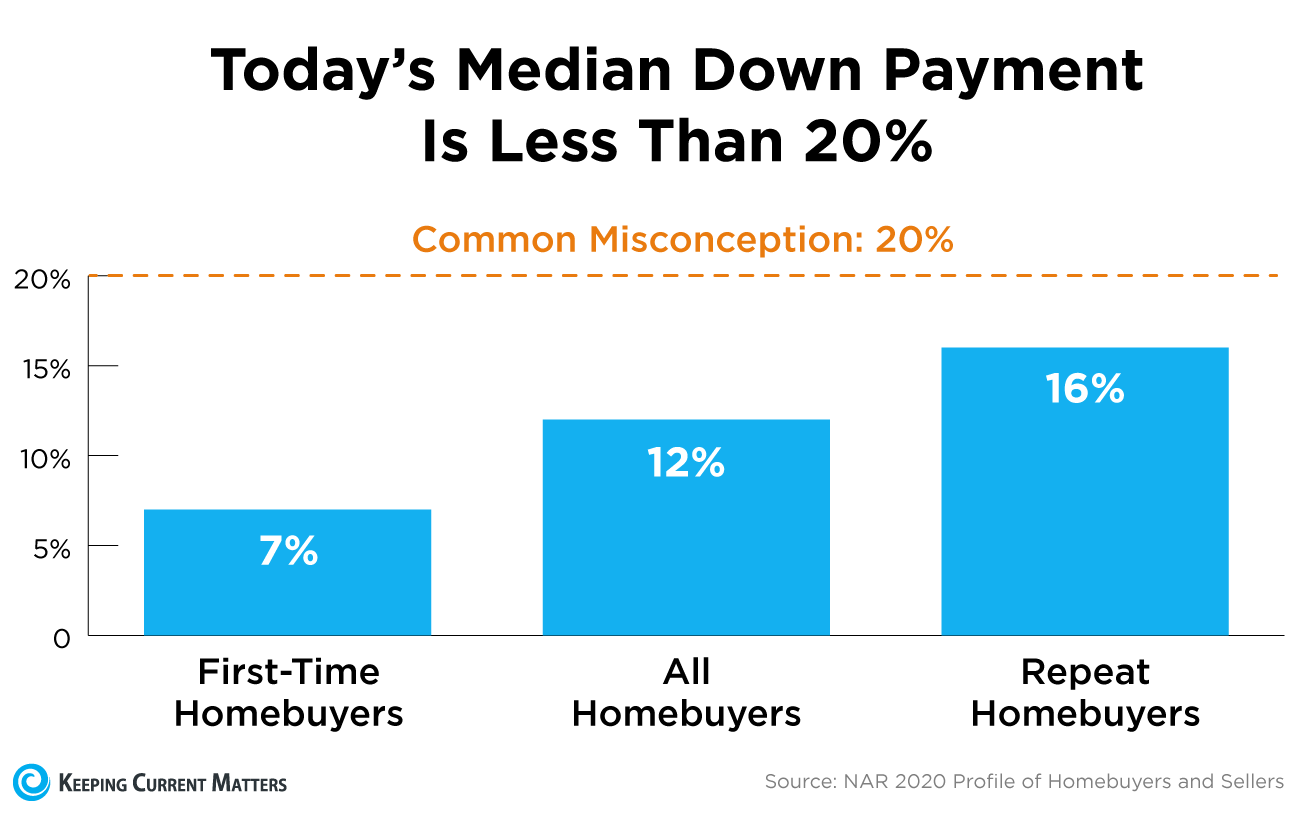
Data in the 2020 Profile of Home Buyers and Sellers from the National Association of Realtors (NAR) indicates that the median down payment actually hasn’t been over 20% since 2005, and even then, that was for repeat buyers, not first-time homebuyers. Today’s median down payment is clearly less than 20%.

What does this mean for potential homebuyers?

The median down payment was lowest for first-time buyers with the 2020 percentage coming in at 7%. If you’re a first-time buyer and putting down 7% still seems high, understand that there are programs that allow qualified buyers to purchase a home with a down payment as low as 3.5%. There are even options like VA loans and USDA loans with no down payment requirements for qualified applicants.

It’s important for potential homebuyers (whether they’re repeat or first-time buyers) to know they likely don’t need to put down 20% of the purchase price, but they do need to do their homework to understand the options available. Be sure to work with trusted professionals from the start to learn what you may qualify for in the homebuying process.

Myth…

Don’t let down payment myths keep you from hitting your homeownership goals. If you’re hoping to buy a home this year, contact a local real estate professional to review your options.

TREC Consumer Protection Notice
Texas Real Estate Commission Information About Brokerage Service
Required DMCA Notice