

Inner Page Background

512.657.8671

Home » Archives for Olga Gilmore » Page 9

Author Archive

Don’t Sell on Your Own Just Because It’s a Sellers’ Market

In a sellers’ market, some homeowners might be tempted to try to sell their house on their own (known as For Sale By Owner, or FSBO) instead of working with a trusted real estate professional. When the inventory of homes for sale is as low as it is today, buyers are eager to snatch up virtually any house that comes to market. This makes it even more tempting to FSBO. As a result, some sellers think selling their house will be a breeze and see today’s market as an opportunity to FSBO. Let’s unpack why that’s a big mistake and may actually cost you more in the long run.

According to the Profile of Home Buyers and Sellers published by the National Association of Realtors (NAR), 41% of homeowners who tried to sell their house as a FSBO did so to avoid paying a commission or fee. In reality, even in a sellers’ market, selling on your own likely means you’ll net a lower profit than when you sell with the help of an agent.

The NAR report explains:

“FSBOs typically sell for less than the selling price of other homes; FSBO homes sold at a median of $217,900 in 2020 (up from $200,000 in 2019), and still far lower than the median selling price of all homes at $242,300. Agent-assisted homes sold for a median of $295,000…Sellers who began as a FSBO, then ended up working with an agent, received 98 percent of the asking price, but had to reduce their price the most before arriving at a final listing price.”

Don’t Sell on Your Own Just Because It’s a Sellers’ Market | Keeping Current Matters

When the seller knew the buyer, that amount was even lower, coming in at $176,700. That’s a lot of money to risk losing when you FSBO – far more than what you’d save on commission or other fees. Despite the advantages sellers have in today’s market, it’s still crucial to have the support of an expert to guide you through the process. Real estate professionals are trained negotiators with a ton of housing market insights that average homeowners may never have. An agent’s expertise can alleviate much of the stress of selling your house and help you close the best possible deal when you do.

Bottom Line

If you’re ready to sell your house this year and you’re considering doing so on your own, be sure to think through that decision carefully. Odds are, you stand to gain the most by working with a knowledgeable and experienced real estate agent. Contact a local professional to learn more about how a trusted advisor can help you, especially in today’s market.

Keeping Current Matters, April 2021
Austin Housing Market vs. Dallas – which is hottest?

There’s no doubt that the Dallas-Fort Worth housing market is jalapeño hot, with homes getting multiple offers on the day they hit market, many of those for far over the asking price, and many offers being cash instead of financed deals.

But for a taste of a housing market that only the strongest can stomach — call it habanero hot — head south on I-35 for about three hours to Austin, where homes are selling for more over asking price than in any major U.S. city.

Austin is being called, by some, the hottest housing market in not only the state, but the nation, depending on how you measure heat. (Is it prices, sales volume, days on market, offers received?)

For more than a decade, DFW has led the state and typically the nation in population growth and job growth, which fuel demand for new and existing homes, said Eric Fite, chief operating officer of DFW-based Century 21 Judge Fite Co. So far in 2021, however, Austin and its surrounding area has slightly surpassed DFW in population growth.

“In the very short-term, year-to-date, Austin seems to have risen to the top in terms of Texas markets, but Dallas is right behind it in terms of population growth,” Fite said. “Houston and San Antonio are also incredible markets right now. Their population growth is a little bit slower paced than what Dallas and Austin are doing, but they’re still very robust, and we’re expecting that to continue into the future.”

Austin sellers getting higher premiums

Austin homes are selling for 7 percent over asking price, the Redfin report says. An average Austin home listed at $400,000 sold for $428,000 from Feb. 14 to March 14, the period analyzed. A year ago, homes in Austin were selling about 1 percent below asking price, the report says. That worked out to the biggest year-over-year gain in any metro area Redfin examined.

Asked whether Austin’s housing market is hotter than DFW’s, Mark Wolfe, broker and owner of RE/MAX DFW Associates, didn’t hesitate.

“Austin is hotter,” he said. “Austin is that perfect city for people from the East Coast/West Coast who don’t want to live in ‘conservative’ Dallas. They like ‘liberal’ Austin. It’s actually hotter in Austin, if you can believe that.”

Excerpts from the Austin Business Journal | By Bill Hethcock  –  Senior Reporter, Dallas Business Journal

The Best Austin Neighborhoods

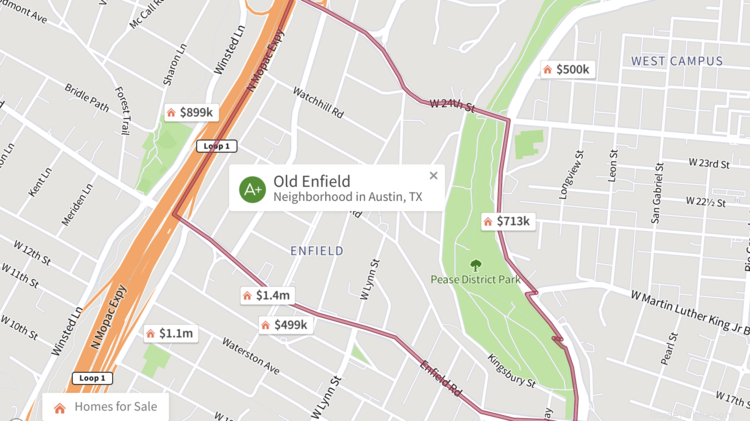
The Old Enfield neighborhood just northwest of downtown Austin is the No. 1 place to live in the city, according to Niche.com — but that kind of living comes with a hefty price tag.

Niche, a website that helps consumers hunt for top neighborhoods and school districts, put the old-school Austin neighborhood atop its list of local neighborhoods and seventh overall in the state. It judges neighborhoods based on metrics such as school quality, diversity, crime and nightlife.

Old Enfield is about a five-minute drive to the offices and nightlife found downtown but has a decidedly non-downtown feel. Perched on the hills above Pease Park, the area is awash with high-end homes — the kind that business moguls and celebrities vie for in this hot housing market.

Here’s what Niche had to say about Old Enfield:

“Living in Old Enfield offers residents an urban suburban mix feel and most residents rent their homes. In Old Enfield there are a lot of bars, restaurants, coffee shops, and parks. Many young professionals live in Old Enfield and residents tend to be liberal. The public schools in Old Enfield are highly rated.”

Dive into more Old Enfield statistics from Niche here.

Old Enfield wasn’t the only local neighborhood to score top marks from Niche. Here are the top 10 local neighborhoods listed on the website:

  1. Old Enfield
  2. Rollingwood west of downtown
  3. Gateway near The Domain
  4. The Triangle area in North Central Austin
  5. Downtown
  6. Old West Austin
  7. West Lake Hills west of downtown
  8. Hyde Park in North Central Austin
  9. Brushy Creek in the suburb of Cedar Park
  10. Allandale in North Central Austin

Austin Business Journal, March 24, 2021

The History Behind St. Patrick’s Day

On March 17th, every year, Americans gather together to celebrate St. Patrick’s Day. Most large cities hold an annual parade to honor the patron saint of Ireland. People dress up in green clothing, eat traditional foods, and enjoy a few drinks to honor the day. There are quite a few traditions that go along with celebrating this special day in March. But what is the history behind St. Patrick’s Day? Below are 10 different interesting facts.

1. St. Patrick Isn’t Even Irish

Patrick was born in 385 CE. His real name was Maewyn Succat, and his precise birthplace is not really known. It’s been speculated that he was was born in Italy, since his parents were believed to have been Roman aristocrats. However, it’s more likely he was born in England, Scotland, or Wales, where the Roman Empire controlled that part of the world.

2. Kidnapped and Enslaved

When he was 16 years old, Patrick was stolen from his family and brought over to Gaelic Ireland as a slave. Working as a shepherd for six years, Patrick believed that God told him to escape to the coast and make his way home. He did just that and thereafter, dedicated his life to the Church. He went back to Ireland 30 years later as a missionary to convert the pagan Irish to Christianity. It was then that he changed his name to Patricius (Patrick), Latin for “father figure.”

3. St. Patrick’s Shamrocks

The shamrock was used by St. Patrick as a metaphor for Christianity. The three-leaved sprig represented the Holy Trinity: The Father, The Son, and The Holy Spirit. The shamrock has since become an iconic symbol of Ireland. Beginning in the early 18th century, people started to wear a shamrock to commemorate St. Patrick’s Feast Day. The day was observed only as a minor religious holy day, mainly in Ireland. It was decided that March 17th would be the date to honor him, as this was believed to be the day on which he died.

4. America Invented St. Patrick’s Day Parades

St. Patrick’s Day was also celebrated in America in the 18th century. Irish soldiers were fighting on the British side during the Revolutionary War in the US. In 1762, those Irish soldiers in New York City held the very first St. Patrick’s Day parade in an attempt to remember their Irish roots from far away. The parade idea caught on, especially with Irish immigrant communities in New York, Boston, Philadelphia, and Chicago. It was a way to honor their patron saint, display their Irish identities, and bond with one another. In fact, the show of solidarity blossomed in 1962, when the city of Chicago dyed a part of the Chicago River green to commemorate the day.

5. Why Wear Green?

The first color associated with St. Patrick was blue, not green. It’s a light shade of blue that is still evident on ancient Irish flags. Over time, though, green became the color that symbolized everything Irish. St. Patrick’s Day celebrates the color green because:

  • The iconic shamrock used by St. Patrick is green
  • Ireland is known as the Emerald Isle for its lush green fields
  • Traditional Irish legend has it that you are invisible to leprechauns if you wear the color green, thereby protecting you from being pinched by one of these fairy creatures

6. What Do Snakes Have To Do With St. Patrick?

It was believed that St. Patrick used his powers to banish all snakes from Ireland. Supposedly, he was able to chase the reptiles to the sea by standing at the top of a hill, now known as Croagh Patrick, and shooing them away with a wooden staff. In actuality, fossil records show that it was too cold for snakes to ever exist in Ireland during the Ice Age. The seas around Ireland have since kept snakes from making their way to the Emerald Isle. The snakes may have been a metaphor for Patrick driving the Pagans from Ireland by spreading Christianity across the country.

7. Traditional Meals

St. Patrick’s Day is traditionally celebrated with a meal of corned beef and cabbage. Although cabbage has always been known as a food of Ireland, corned beef didn’t make that leap until the beginning of the 19th century. It was Irish immigrants living on the Lower East Side of New York City who began to substitute corned beef for Irish bacon.

8. The Holiday Needs Music

Music and Irish culture go hand-in-hand. The Celts passed on their history, legends, and religious beliefs orally through stories and songs. Once the English took over their land, the Irish were not allowed to speak their native language. So they turned to music to retain their heritage, even though it was against the law to do so. Today, traditional Irish music is very popular around the world. With a type of bagpipes called uilleann pipes, fiddles, tin whistles, and the bodhranm St. Patrick’s Day Parades would not be quite as enjoyable as they are.

9. The Most Important Thing To Drink

In Ireland, drinking a pint of Guinness is a longstanding tradition. That tradition has made its way to America, particularly on St. Patrick’s Day. Guinness is a dark Irish beer that has an acquired taste, yet 13 million pints of it are imbibed around the world every March 17th. These days, many American bars tint the beer green in honor of the day.

10. St. Paddy or St. Patty?

You’ll probably hear some people refer to St. Patrick’s Day as St. Patty’s or St. Paddy’s Day. This is just a quick, casual way of referring to the holiday. Using the name, Patty would be technically incorrect, though. In Ireland, a shortened version of the name Patrick would be Paddy. Patty is a nickname for a female named Patricia, so that doesn’t really work at all!

Are You Looking to Adopt?

We’re on record as being big-time animal lovers.

In fact, when meeting a new person, we’ve been known to ask what their dog’s name is before their own! Kinda rude? Yup! But hey, it’s not our fault that dogs tend to have cooler, more memorable names than say, Chris, or Ed. Anyway, we digress. Because we are such fans of cats, dogs, and everything in between (Catdog?), we decided to put together a page for the purpose of showcasing some of the best adoption resources for giving some of the cutest animals in Austin a forever home.


Austin Pets Alive!

Arguably the most famous pet rescue in Austin, APA! has cats and dogs in its downtown Austin location, as well as some in foster throughout the city. Austin Pets Alive! is a no-kill shelter committed to rehabilitating at-risk pets and reducing euthanasia rates across Austin. APA! also has a barn cat program, where they place non-traditional cats that are feral or non-socialized with owners that can give them a safe shelter.

Austin Animal Center

Austin Animal Center is the city-sponsored animal shelter that provides rehabilitation programs for at-risk pets and strives to reduce the number of homeless pets in Austin. The center is an open-intake facility that accepts all homeless pets regardless of breed, size or temperament.

Love-A-Bull

The Love-A-Bull dog rescue seeks to help homeless pit bulls find a forever home but has also made it its mission to adjust the stereotypes of pit bulls through education and advocacy programs. The rescue is 100% volunteer-run, with no paid positions on its roster.

Austin Siamese Rescue

The Austin Siamese Rescue is a private shelter that doesn’t have a public space, but rather homes all of their adoptable cats in foster homes. The shelter focuses on the 14 breeds of the Royal Thai Family, including Siamese, Balinese, Javanese, Oriental Shorthairs and Longhairs, Birmans, Burmese, Himalayans, Ocicats, Ragdolls, Snowshoes, and Tonkinese cats.

Lizzy’s Animal Hospice

Lizzy’s Animal Hospice works to provide the most vulnerable shelter dogs – those who are elderly or terminally ill – with a loving home in which to spend the rest of their life. Lizzy’s Animal Hospice was founded on the idea that all dogs deserve a loving and comforting end of life, and seeks to provide that for this vulnerable population. Lizzy’s Animal Hospice also runs Lucky Mutts, a dog rescue organization with younger/healthy dogs that Lizzy’s brings in mistakenly or by choice.

House Rabbit Resource Network

The House Rabbit Resource Network advocates for the livelihood of house rabbits by educating owners about proper rabbit care and facilitating the adoption process for homeless rabbits and potential owners. The resource works not only to facilitate these adoptions but also to provide education about how rabbit owners can take better care of their new pet.

Forgotten Friends Mixed Breed Rescue

The Forgotten Friends rescue is devoted to rescuing mixed-breed dogs and finding them suitable homes. The program has existed for 20 years and is a 100% volunteer-run organization. Mixed-breed dogs enter the program from area shelters, then the rescue finds a suitable foster home and, eventually, adopter.

New Hope Animal Rescue

After volunteering at area shelters and seeing how desperate they were for rescue support partners, Kelley Rice founded New Hope Animal Rescue. New Hope works to reduce the number of dogs that are euthanized in shelters each year by advocating for animal adoption over purchase from breeders and educating the public about the importance of spaying and neutering.

Wee Rescue

The Wee Rescue works with the Austin Animal Center to place small dog breeds – such as Havanese, Lhasa Apsos, Pekingese Shih Tzus – in forever homes. All of the small dogs are spayed/neutered, receive shots and get microchipped before they are made available to adopt. They also spend at least two weeks in a foster home so potential adopters can get a sense of their personality and triggers.

Purrfect Pals Rescue

The Purrfect Pals Rescue specializes in particularly at-risk kittens that require round-the-clock care and bottle feeding. They work to rehabilitate these kittens and prepare them for placement in a forever home, with the goal of reducing the euthanasia rates among kittens that need extra care.

Austin Humane Society

The Austin Humane Society is the largest non-profit and no-kill shelter in Austin. It is also the longest-standing shelter in the city, as it has been in service since 1952. Similar to other large-scale shelters in the city, the Humane Society is dedicated to safely rehoming pets and educating the public about responsible pet ownership.

CONTRIBUTED BY EMILY GIBSON | Do512

TREC Consumer Protection Notice
Texas Real Estate Commission Information About Brokerage Service
Required DMCA Notice